
The RONGHUA Journal · Materials & Stories
Before a stone becomes something we wear, it has already lived a story of its own.
Its color comes from minerals. Its patterns hold traces of how it formed. We find it, cut it and polish it, bringing something once hidden inside rock into the small rituals of everyday life.
The history of agate jewelry begins with this simple fascination: the wish to keep a little of the natural world close.
A History Written in Beads and Carved Stone
People have worked with agate and its close relative, carnelian, for thousands of years. Both belong to the chalcedony family. Agate is especially associated with banding and patterns, while carnelian is known for its translucent orange-to-red color.
Ancient Egyptian necklaces and beads from Mesopotamia preserve evidence of this long relationship. A carnelian necklace in the Fitzwilliam Museum dates to around 3000 BCE; beads from ancient Ur show how red stones were worn alongside gold and lapis lazuli.
These small objects tell a larger story of skilled hands, personal adornment and materials moving between distant places.
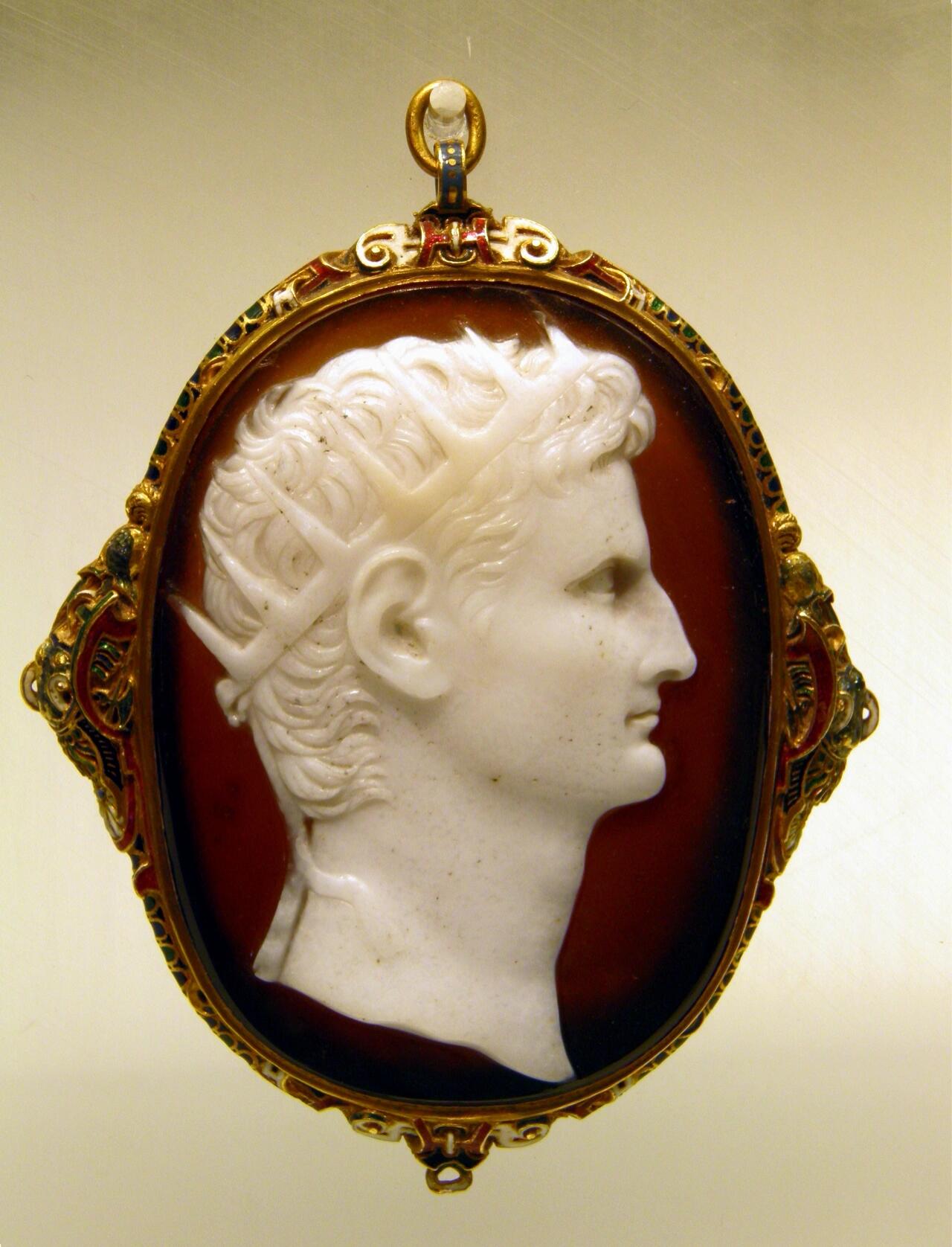
Roman gem carvers also found possibilities in layered chalcedony. By carving through a pale layer above a darker ground, they could reveal faces, drapery and elaborate scenes. The celebrated Gemma Augustea, carved in double-layered sardonyx, is one surviving example.
In China, agate has appeared in beads, ornaments and objects made for the scholar’s desk. Surviving Qing-dynasty court necklaces also show its place in ceremonial dress. Across these different settings, the same material has carried many forms of meaning.
How Agate Forms
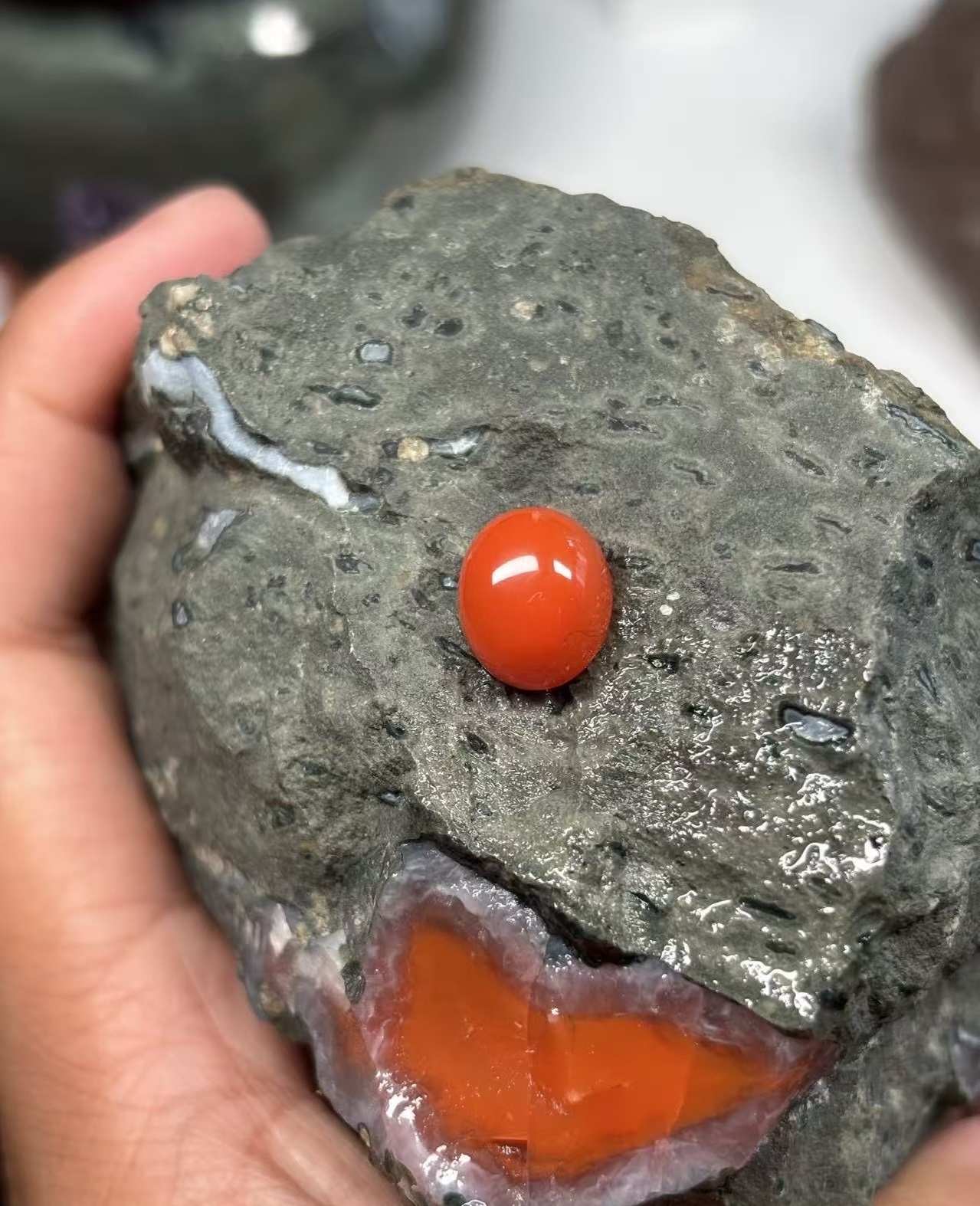
Agate is made of microscopic quartz crystals. Many agates develop inside cavities in rock, including spaces left by gas bubbles in volcanic material. Silica-bearing fluids enter these spaces, and minerals gradually accumulate.
Changes during formation can leave bands, clouds and contrasting layers. Other stones show subtler transitions or more even color. Their appearance reflects a complex geological process, rather than a single pattern repeated from stone to stone.
Cut open a piece of rough material, and something unexpected may appear: a ring of pale color, a soft boundary, a line that seems to follow its own quiet path. We sometimes recognize landscapes in these details. Nature has already drawn the first lines.
What Is Nanhong Agate?
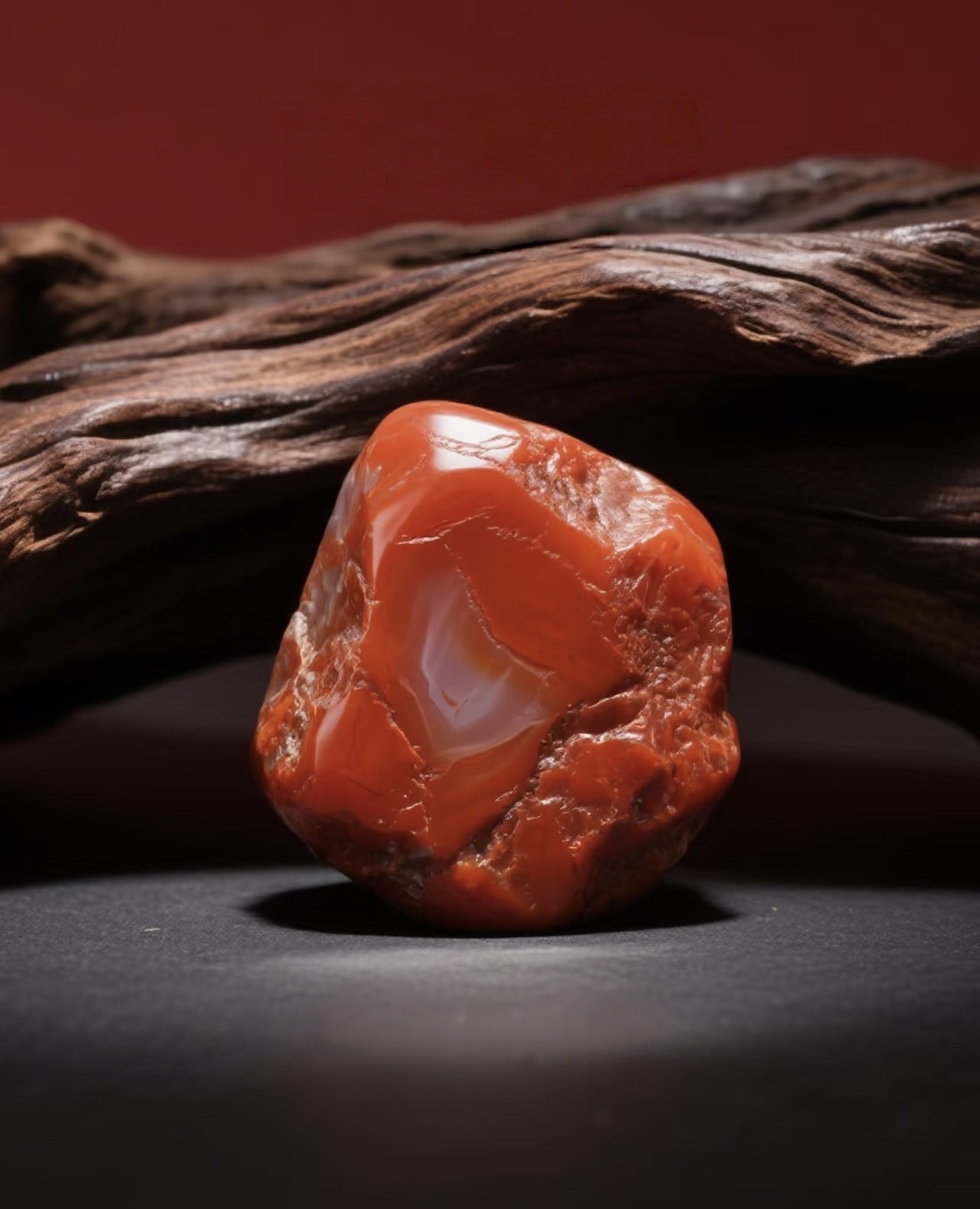
Nanhong is a red variety of agate closely associated with China. Baoshan in Yunnan and Liangshan in Sichuan are important sources discussed in gemological research. Its name brings together the Chinese words for “south” and “red.”
Fine hematite inclusions contribute to its characteristic color, which can range from orange-red to deeper, purplish red. Some pieces appear richly saturated; others have translucent edges or visible changes in tone.
These differences are part of what makes Nanhong agate jewelry so engaging to look at closely. A small bead can hold more variation than it first reveals.
Worn against the skin, its red becomes a warm accent: a little color at the wrist, beside the face or near the collarbone.
How to Appreciate Agate: Color, Pattern and Texture
There is no single appearance that makes every kind of agate beautiful. It helps to look at each stone in the context of its variety, condition and intended use.
Color
Look at the depth of color, its distribution and the way one shade moves into another. Saturated red may be desirable in Nanhong, while a banded agate may be appreciated for the contrast between its layers. Uniformity and variation can each have their appeal.
Pattern
Fine bands, broad curves and moss-like inclusions offer different kinds of detail. Notice whether a pattern feels distinct, balanced or simply unusual to you. Natural patterns do not need perfect symmetry to be worth keeping.
Texture and Condition
Consider translucency, fractures, surface condition and the quality of the polish. Shine alone cannot determine quality: the finish and the way a stone is photographed both influence what we see.
When buying agate jewelry, ask about any known treatments, including dyeing, heating or filling. A stone’s appearance alone does not reliably establish its treatment history. Clear material information helps you make an informed choice.
From Stone to Something Personal
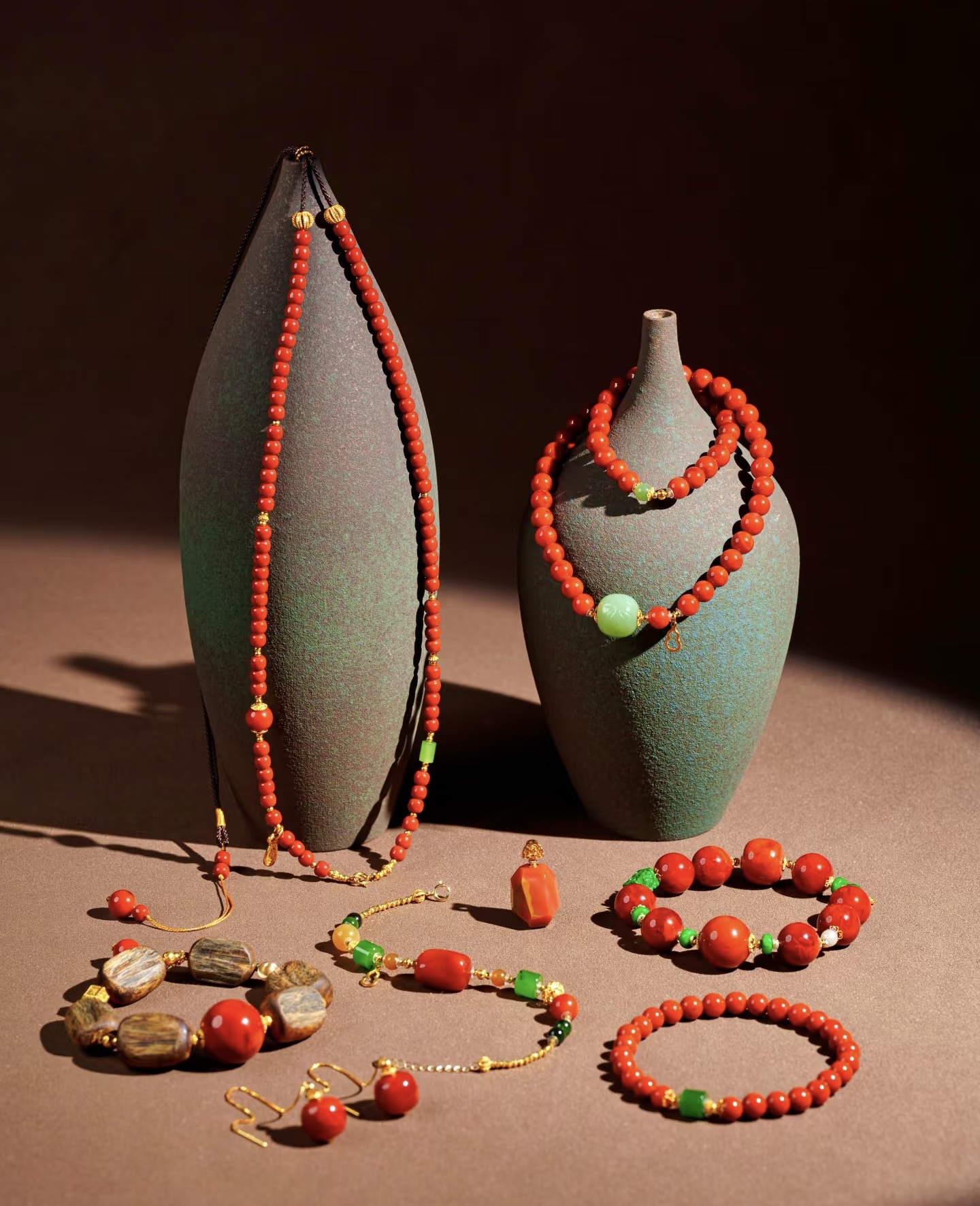
A bead strand, a pendant and a pair of earrings each give the material a different rhythm. Repeated beads bring continuity. A single stone draws attention to a particular shape or patch of color.
The piece you choose may become familiar through ordinary moments: fastening it before leaving, feeling it move as you reach for something, setting it down at the end of the day.
RONGHUA · A Light of Your Own
We are drawn to agate because its character is already there: a deeper red, an unexpected line, a transition that will never repeat in quite the same way.
Your lasting light comes from the life you live: the paths you take, the choices you make, the relationships you nurture, and the person you are still becoming.
Jewelry adds a small touch of color along the way. The story remains yours.
Find Your Touch of Red
Explore agate jewelry to wear in your own way.
-

Carry the Warmth — Agate Wrap
$149.65 Add to cart -
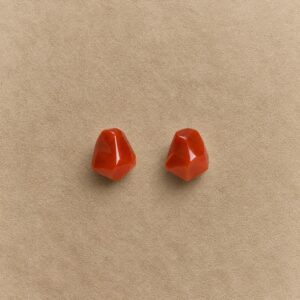
Crimson Serenity — Agate Studs
$59.78 Add to cart -
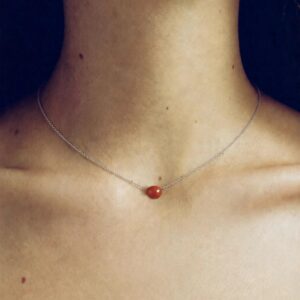
ZHUSHA ZHI — Natural Red Agate Necklace
$69.79 Select options This product has multiple variants. The options may be chosen on the product page -

As You Are — Mismatched Earrings
$98.78 Add to cart